
Fitness After 50: The Minimum Effective Dose
Here's a dirty secret from more than thirty years of training: about 80% of my results come from 20% of what I do. The basics — squats, hinges, pushes, pulls, carries, and walking — account for nearly all of the functional strength and health benefits. The rest of what the fitness industry sells you accounts for maybe the remaining 20%, at best. The industry profits from making you feel inadequate. Ignore most of it.
This is liberating once you accept it. You don't need to do everything. You need to do the right things, consistently.
What you're actually training for
You are not training to look good at the beach this summer. You are training so that your 75-year-old self can get up off the floor without help — so you can play with grandchildren, travel without accommodation, carry your own luggage, open your own jars. The research on what predicts functional independence in older age is consistent: muscle mass, grip strength, cardiovascular fitness, and mobility. Not aesthetics. Not max numbers. Write down what you want to be able to do at 75, and train for that.
The minimum effective week
Two to three full-body strength sessions of 45–60 minutes. Compound movements: a squat, a hinge, a push, a pull, a carry. Two well-designed sessions preserve nearly everything you've built; three can build new strength. More than that is fine if you enjoy it and can recover — but it's not required.
Daily walking, around 10,000 steps. Non-negotiable. It burns fat, aids recovery, maintains cardiovascular health, and costs nothing. It's the foundation of the whole program.
One athletic day you enjoy — golf, pickleball, hiking, swimming. It satisfies the competitive drive without the structure of training. (Pickup basketball at fifty is an orthopedic surgeon's retirement fund. Choose accordingly.)
The every-third-day rule
Here's the one piece of mechanics where most people over fifty quietly hurt themselves. Muscle recovers in about forty-eight hours. Tendons and connective tissue need seventy-two-plus. When you train on the muscle's schedule, you chronically under-recover the tendons. You won't feel it for a year. Then you'll feel it for a decade. Full-body, every third day — Monday, Wednesday, Friday, or any spread with a recovery day between sessions — is how you train hard and still have working joints at seventy. The days between aren't rest days; they're walking, mobility, recovery. The guy doing twelve impressive weeks followed by an injury loses to the guy doing eighty percent, consistently, for twelve years. Every time.
Respect the warning signs
Your body after fifty is not the body you had at twenty-five, and ignoring that reality is how you get injured. Sharp pain during a movement is a cease-and-desist letter: stop immediately. Pain that persists more than seventy-two hours after training means you've crossed from stimulus to injury. Numbness, tingling, joint swelling, fatigue that rest doesn't fix — see a doctor. That's not weakness. That's intelligence. You cannot out-train a problem that requires medical attention.
And one honest note nobody talks about: there's real grief in losing your athletic identity. I had a big arm for a little guy — I could throw a baseball from deep center to home plate. That was decades ago, and I still miss it. Grieve your younger athletic self. Then redirect the drive — against yesterday's numbers, into mastery rather than victory. Motivation is a feeling, and feelings are unreliable. What carries you through isn't willpower. It's structure.
THE FREE NEXT STEP
The Reconstruction Toolkit pulls the core checklists and first steps from the whole system into one free download
THE DEEP DIVE
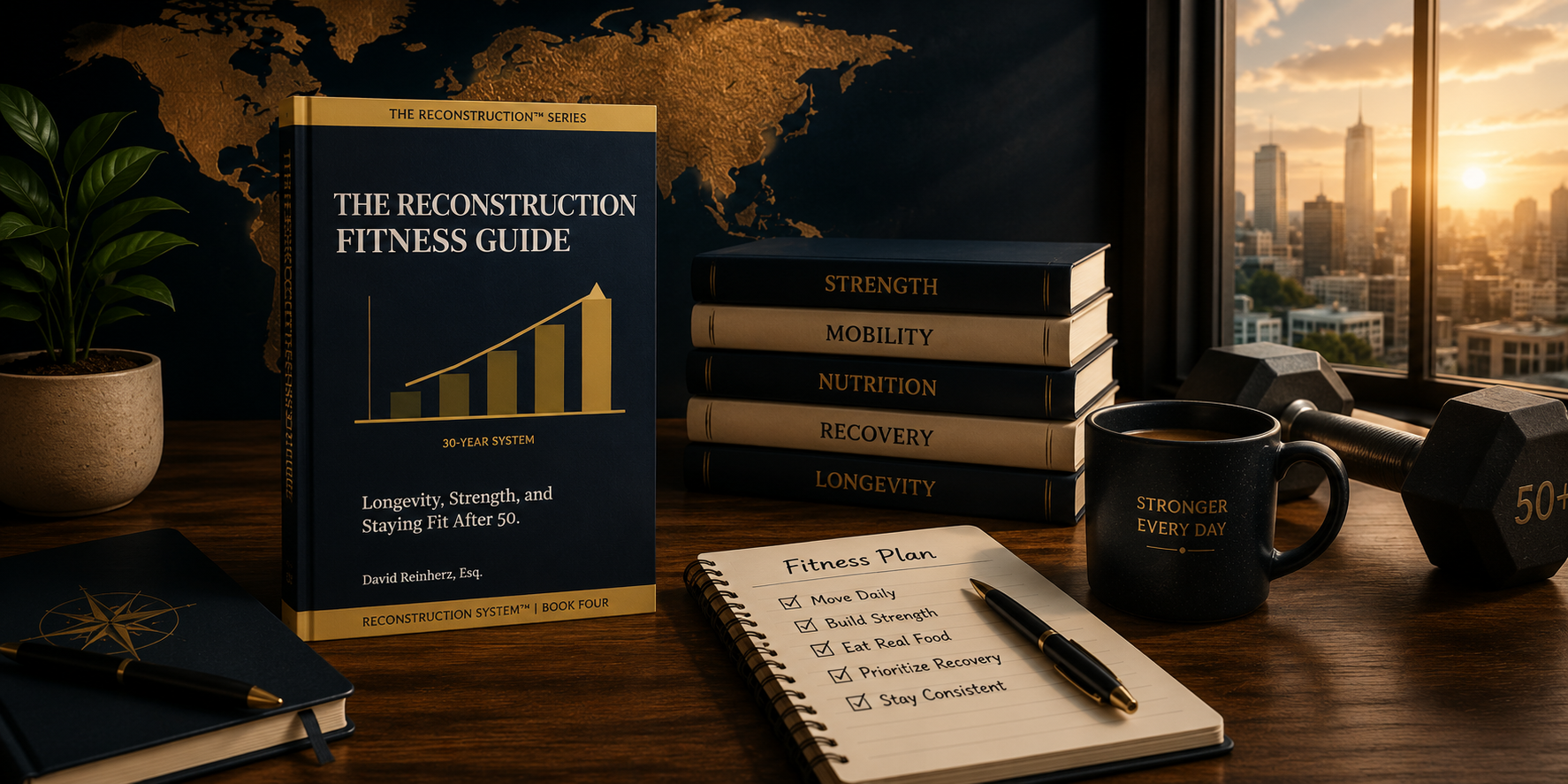
This article scratches the surface of THE RECONSTRUCTION FITNESS GUIDE (Book 4) — and when you're ready to go deeper, THE 50+ BODY RECONSTRUCTION (Book 8) — available on Amazon.