

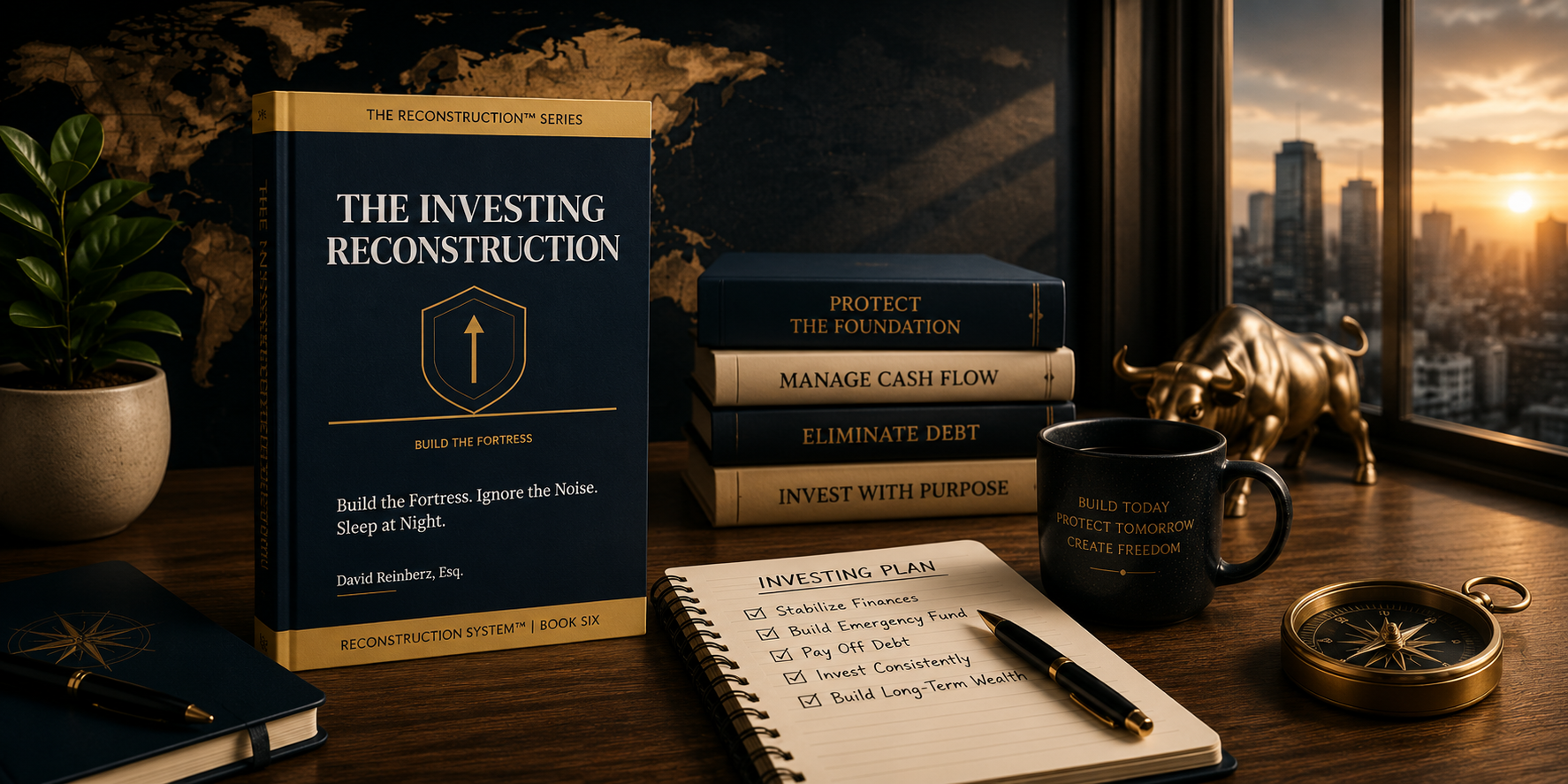
Investing After a Setback Build the Fortress First
The financial rebuild has exactly one prerequisite, and almost everyone tries to skip it: you cannot make a good decision from genuine financial panic. So before we talk about growth, before we talk about returns, we build a floor. A floor is what lets you think. It's the difference between investing and gambling — and the only real difference is whether you can sleep.
The three buckets
The structure is three buckets, and each has exactly one job.
Bucket one: the Fortress. Cash, T-bills, money market. It does not grow, and it's not supposed to. Its job is protection — months of real expenses, the number you get from your last three bank statements, not the number you wish were true. The Fortress earns nothing but peace of mind, and peace of mind is the highest-yielding asset you own in a crisis. When markets crash, the Fortress is what lets you wait instead of panic-sell.
Bucket two: the Compounders. Low-cost index funds, quality dividend payers, debt-free real estate. Ten-year horizon, minimum. You do not sell from bucket two to cover a short-term problem — that's what bucket one is for.
Bucket three: the asymmetric shots. High-upside, high-risk positions. It exists, it's a small single-digit slice of your net worth, and it comes last — after the Fortress is full, after the debt above eight percent is gone, after the index contributions are automatic. A rule broken without a cage isn't conviction. It's gambling with extra steps.
The monthly order of operations
The part that makes the system run is one decision, made once, followed every month in order with no deviation: emergency reserve first. Then max the tax-advantaged accounts. Then Fortress to target. Then Compounders to target. And only then, if everything above is satisfied, the asymmetric sleeve. You're not deciding under pressure — you decided once, and now you just follow it.
When I look at real portfolios after a setback, I see the same picture: underweight the Fortress, overweight noise — a thin cash cushion and a pile of stuff the owner can't quite explain owning. That's a portfolio built by accumulation, not by design. Flip it. Boring compounding beats drama. It always has.
Starting late is not a life sentence
Starting over at forty-five or fifty with a fraction of what you had feels terrifying. But the system scales, and the principles don't change: build the Fortress, automate the contributions, increase the savings rate to compensate for lost time, and let the math work. The goal after a setback isn't to get rich fast — that impulse is exactly what makes crises longer. The goal is to become solvent, then unshakeable, in that order. Rich is what the boring machine produces if you leave it alone long enough.
THE FREE NEXT STEP
The Reconstruction Toolkit pulls the core checklists and first steps from the whole system into one free download
THE DEEP DIVE
This article scratches the surface of THE INVESTING RECONSTRUCTION — Build the Fortress. Ignore the Noise. Sleep at Night. (Book 6) — available on Amazon.