

How to Rebuild Your Life After Divorce, Bankruptcy, or Crisis
By the time most people start searching for how to rebuild their life, they already know something has broken. The marriage cracked. The money collapsed. The health scare landed. I've sat across the desk from thousands of people at exactly that moment — I've been a bankruptcy and family law attorney for nearly thirty years — and I can tell you the single biggest difference between the people who rebuilt well and the people who stayed stuck.
It wasn't willpower. It wasn't money. It was sequence.
Survive, rebuild, thrive — in that order
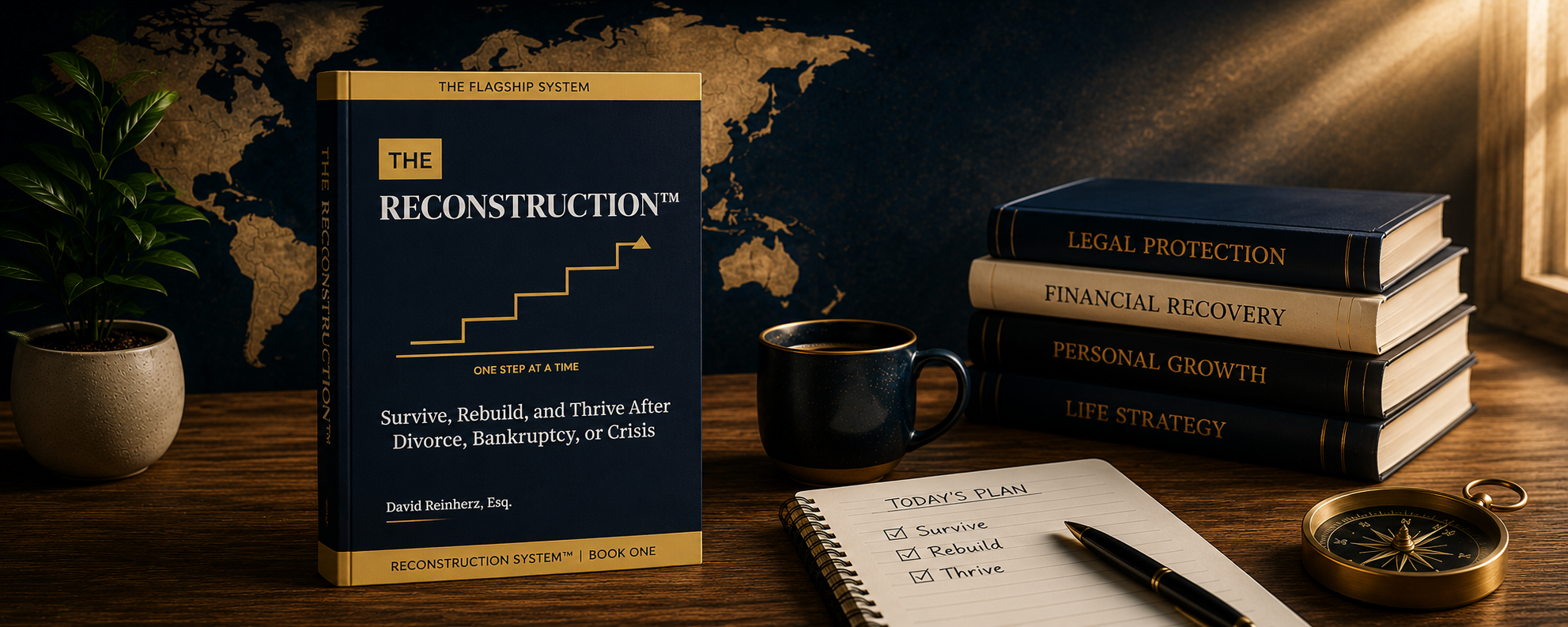
Every reconstruction follows the same three stages, and they don't work out of order. Survive: stop the bleeding. Get legal protection if you need it, stop the collection calls, stabilize your cash flow, get a night's sleep. Rebuild: fix the structure — the finances, the living situation, the health, the habits. Thrive: only then do you optimize, invest, grow, and start reaching for the interesting stuff.
The world is structured to sell you the exciting part first. Stock picks before emergency funds. Reinvention retreats before a budget. I've watched hundreds of people try to shortcut from crisis to thriving, and almost all of them made the crisis longer and more expensive. The sequence is not a preamble to the strategy. The sequence is the strategy.
The four pillars
A life that doesn't collapse every time the wind changes direction rests on four pillars: Law, Money, Body, and Identity. They interact. A legal crisis drains the money. A money crisis wrecks the sleep, and the body. A wrecked body makes terrible decisions — I have watched clients make catastrophic, irreversible choices at two in the morning that they never would have made at ten a.m. with a night's rest behind them. And underneath all of it sits identity: the story you tell yourself about who you are now.
The practical move is to rate yourself honestly on each pillar, identify the weakest one, and start there. Not everywhere at once. There.
Baby steps and the 80/20 rule
People overestimate what they can do in a week and underestimate what they can do in a year. Everything I've rebuilt — finances, fitness, business, identity — came from small moves, repeated. Moves that didn't look like much on any given day and compounded into everything over time.
Pair that with the most useful mental model I know: roughly 20% of your actions create 80% of your results. In a crisis, most people chase noise — they try to fix everything, which means they fix nothing. The 80/20 rule is permission to simplify. Find the few things that actually move the needle in your situation, and do those, consistently, and let the rest go.
Where to start today
Write down the real numbers. What comes in, what goes out, what's owed, what's behind. Not the hopeful version — the honest one.
Name your weakest pillar in one word. Law, Money, Body, or Identity. That's where the work starts.
Pick the smallest step that would make you feel like you're moving, and do it before you sleep tonight. Crisis kills momentum. Motion is the antidote, and it doesn't have to be big. It has to be real.
You are not your divorce, your bankruptcy, or your worst year. Reconstruction isn't a comeback story — it's a clarity story. It's the moment you stop asking "why did this happen to me?" and start asking "what do I build next?"
THE FREE NEXT STEP
The Reconstruction Toolkit pulls the core checklists and first steps from the whole system into one free download
THE DEEP DIVE
This article scratches the surface of THE RECONSTRUCTION — Survive, Rebuild, and Thrive After Divorce, Bankruptcy, or Crisis (Book 1) — available on Amazon.