
Rebuilding Your Identity After Divorce, Bankruptcy, or Crisis
I've helped thousands of people through the legal side of a collapse — the divorce decree, the bankruptcy discharge, the settlement. And I'll tell you what I noticed, over and over: the paperwork ends, and the person is still standing in the wreckage asking the harder question. Who am I now?
The lawyer can't answer that one. Neither can the judge. But after watching who rebuilt and who didn't for nearly thirty years, I can tell you how the ones who rebuilt did it — and it wasn't a lightning-bolt reinvention. It was structure.
dentity isn't fixed. It's built.
The identity that collapsed — spouse, provider, business owner, athlete — was built by years of repeated actions and stories. The new one gets built the same way. Not by deciding who you are, but by doing, in small doses, what the person you're becoming would do. Systems beat motivation every single time, and nowhere more than here.
Minimum-dose discipline
The same principle that governs the training program governs the identity rebuild: the minimum effective dose. You don't need a monastic reinvention. You need a handful of small, daily, keepable promises to yourself — because every kept promise is a brick, and every broken one confirms the old story. A short morning routine you actually do. A walk. Ten minutes of stillness without the mystique — breathing, or just quiet, whichever you can keep. The point isn't the practice. The point is being a person who does what he said he'd do, at a dose small enough that you never fail.
Watch the stories
After a collapse, your brain will offer you a story: "the person who lost everything," "the one who got left," "the failure." Some of those stories you wrote; most you inherited. You don't have to argue with them — you have to outvote them with evidence. Every small kept promise is a vote for a different story: "the person who learned and built again." That's not positive thinking. It's just how the ledger works.
Purpose is quieter than you've been told
The self-help world sells purpose as a thunderclap — a passion you discover on a mountaintop. In my experience purpose mostly feels like the quiet satisfaction of competence: getting good at things that matter to people you care about, and letting meaning accumulate the way wealth does — slowly, boringly, through compounding. You are allowed to rebuild. You are allowed to outgrow the first version of your life. Reconstruction isn't a comeback story. It's a clarity story — the moment you stop asking "why did this happen to me?" and start asking "what do I build next?"
THE FREE NEXT STEP
The Reconstruction Toolkit pulls the core checklists and first steps from the whole system into one free download
THE DEEP DIVE
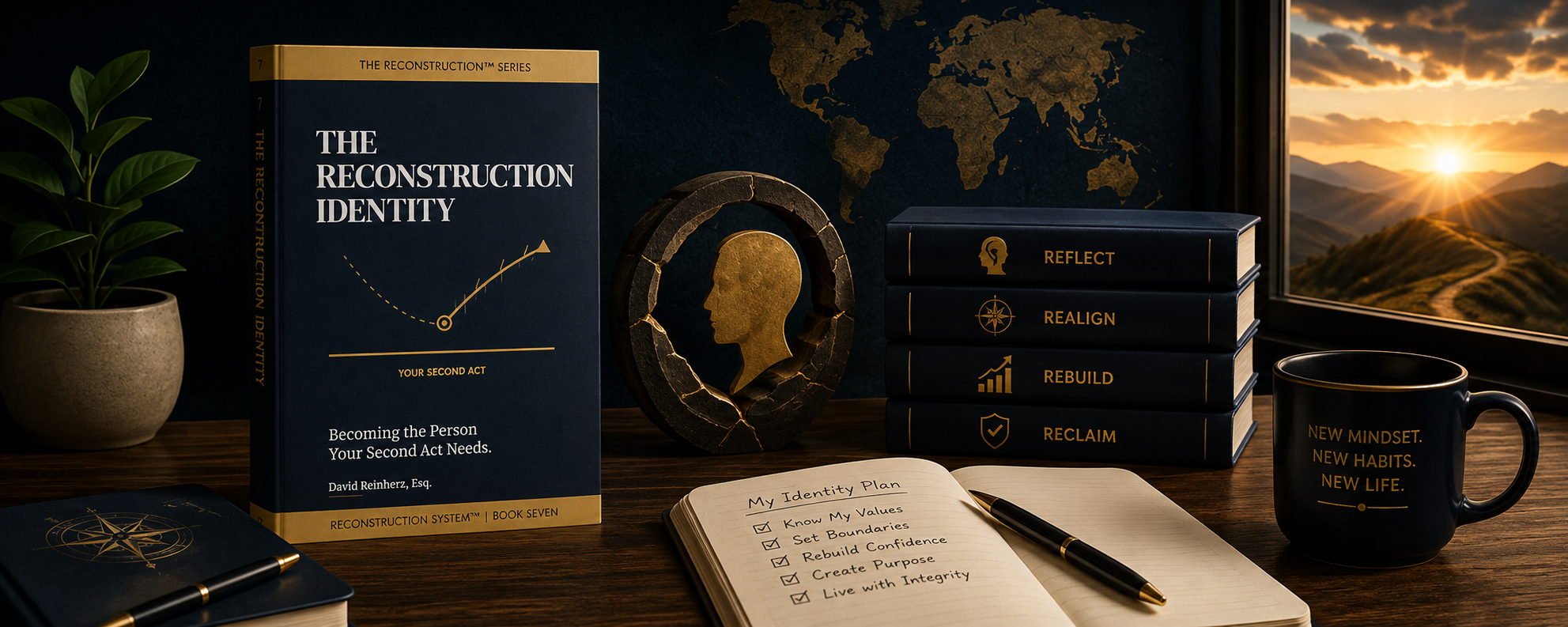
article scratches the surface of THE RECONSTRUCTION IDENTITY — Becoming the Person Your Second Act Needs (Book 7) — available on Amazon.